


How Do You Know What Your Coins Are Really Worth?
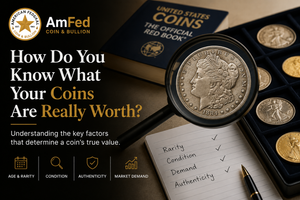

How Do You Know What Your Coins Are Really Worth?
One of the biggest misconceptions I encounter is that determining the value of a coin is as simple as looking up a price online.
If only it were that easy.
Over the years, I've had people walk into our showroom convinced their coin collection was worth a fortune, only to discover it consisted of common coins with little collector demand.
I've also seen the opposite happen.
Someone brings in an old coffee can filled with coins inherited from a grandparent, assuming they're only worth face value. Hidden among them is a coin worth hundreds—or even thousands—of dollars.
The difference isn't luck.
It's understanding what creates value.
Age Doesn't Automatically Make a Coin Valuable
This is probably the biggest myth in numismatics.
Just because a coin is old doesn't necessarily make it rare.
The United States Mint has produced billions of coins over the years. Many are old, but many were also produced in such large quantities that they're still common today.
Age is only one piece of the puzzle.
Rarity Matters
Collectors pay premiums for coins they have difficulty finding.
That rarity may come from:
- A low mintage
- A particular mint mark
- A production error
- A limited survival rate
- Strong collector demand
Sometimes a coin that appears ordinary is actually one of the hardest dates in an entire series.
Condition Can Make an Enormous Difference
Condition is often the single biggest factor affecting value.
Imagine two identical Morgan Silver Dollars from the same year and mint.
One spent decades in circulation.
The other remained untouched in a collection since the day it was minted.
They contain the same amount of silver.
Yet one may be worth several times more simply because of its condition.
That's why collectors pay close attention to grading.
Original Surfaces Matter
One mistake I wish fewer people made is cleaning coins.
It seems logical.
If something looks dirty, clean it.
Unfortunately, cleaning can permanently reduce a coin's collector value.
In many cases, a naturally toned coin is worth considerably more than one that has been polished.
If you're unsure, don't clean it.
Have it evaluated first.
Bullion Value vs. Collector Value
Some coins are purchased primarily for the precious metal they contain.
Others are purchased because collectors want them.
Many coins fall somewhere in between.
Understanding that difference is essential before selling.
A coin worth $2,500 to a collector should never be sold simply for its gold or silver content.
Online Price Guides Only Tell Part of the Story
The internet is an excellent resource—but it isn't always accurate.
Many websites list asking prices rather than actual selling prices.
Others don't account for condition, certification, or current market demand.
Without experience, it's easy to compare your coin to the wrong example.
Certification Adds Confidence
Professional grading services such as PCGS and NGC help establish authenticity and condition.
Certification doesn't automatically make every coin more valuable, but it often provides buyers and sellers with greater confidence.
For certain coins, certification can make a significant difference in marketability.
Why Professional Appraisals Matter
A professional appraisal isn't simply someone quoting a number.
It's an opportunity to understand:
- What you own
- Why it's valuable
- Whether it should be certified
- Whether it's better suited for collectors or bullion buyers
- Current market demand
Even if you decide not to sell, that knowledge has value.
Final Thoughts
Every collection has a story.
Some are built over generations.
Others are inherited unexpectedly.
Whether you own a single coin or an entire collection, understanding its value begins with education—not assumptions.
Before you decide to sell, make sure you know exactly what you have.
You may discover it's worth more than you ever imagined—or gain the peace of mind that comes from knowing its true value.
Either way, knowledge is always your best investment.
Nick Grovich
President, AmFed Coin & Bullion
This article is provided for educational purposes only and should not be considered financial, tax, or investment advice. Coin values fluctuate based on collector demand, market conditions, rarity, and precious metal prices.
- Nick Grovich
