


Why One Coin Dealer May Offer More Than Another: What Every Seller Should Know
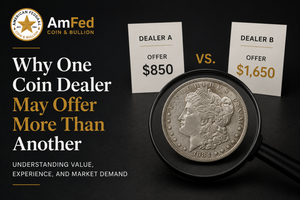

Why One Coin Dealer May Offer More Than Another
One of the most common questions I hear is:
"Why did I receive two completely different offers for the same coin?"
It's a fair question.
Most people assume a coin or gold bar has one value, so every dealer should offer roughly the same amount.
In reality, that's almost never the case.
After more than forty years in the rare coin and precious metals business, I can tell you there are many reasons why two reputable dealers may arrive at different offers—and understanding those reasons can help you make a much more informed decision.
Not Every Dealer Has the Same Business Model
Some dealers specialize in bullion.
Others specialize in rare coins.
Some focus primarily on jewelry.
Others work with collectors every day.
If someone primarily buys gold to melt, they may overlook the collectible value of certain coins.
A dealer who regularly works with collectors may recognize that same coin has significant numismatic value beyond the precious metal it contains.
That's one reason two offers can be very different.
Bullion Value Isn't Always the Whole Story
Many people are surprised to learn that two gold coins containing the exact same amount of gold can sell for very different prices.
Why?
Because collectors don't just buy precious metals.
They also buy rarity.
A coin's value may depend on:
- Date
- Mint mark
- Condition
- Population reports
- Certification
- Historical demand
- Collector interest
If those factors aren't considered, a seller may unknowingly accept far less than their coin is actually worth.
Experience Makes a Difference
Evaluating coins isn't simply weighing metal.
It requires experience.
Two coins may look nearly identical to someone unfamiliar with the hobby.
An experienced numismatist may immediately recognize that one is common while the other is significantly more desirable.
That's knowledge developed over decades—not something that can be replaced with an online price guide.
Every Dealer Has Different Costs
This is something many people never consider.
Every business has different operating expenses.
Some dealers maintain large inventories.
Some advertise nationally.
Others primarily buy to fulfill customer demand.
Because of these differences, every dealer has a different amount they're willing—or able—to pay.
Receiving different offers doesn't necessarily mean one dealer is dishonest.
It simply means businesses operate differently.
The Highest Offer Isn't Always the Best Decision
This may sound surprising coming from someone who buys precious metals.
The highest offer isn't always the best choice.
Ask yourself:
- Did they explain how they arrived at the value?
- Did they answer your questions?
- Did they identify rare or collectible items?
- Did they pressure you to sell immediately?
- Do they have a long-standing reputation?
Price matters.
Trust matters just as much.
Always Ask Questions
A reputable dealer should welcome your questions.
Ask:
- Why is this coin worth what it is?
- Is this being valued as bullion or as a collectible?
- What factors influenced your offer?
- Would certification increase its value?
- Should I obtain another opinion?
An honest dealer won't be offended.
In fact, they should encourage it.
Get More Than One Opinion
I tell people this all the time.
If you're selling something valuable, don't feel obligated to accept the first offer you receive.
Take the time to compare.
Ask questions.
Learn about what you own.
An informed seller almost always makes better decisions.
Education Protects You
At AmFed Coin & Bullion, we've spent more than four decades helping customers understand the true value of their coins and precious metals.
Sometimes that means explaining why an offer is fair.
Other times, it means telling someone they should hold onto a coin because its collector value exceeds its bullion value.
Either way, our responsibility is to educate first.
When you understand what you own, you're in a much stronger position to decide what to do with it.
Final Thoughts
Receiving different offers doesn't necessarily mean someone is trying to take advantage of you.
But it does highlight why experience, transparency, and education matter.
Before selling your coins, gold, silver, or other precious metals, make sure you understand exactly what you're selling and why it's worth what it is.
The best dealers don't just make offers.
They help you understand them.
Nick Grovich
President, AmFed Coin & Bullion
This article is provided for educational purposes only and should not be considered financial, tax, or investment advice. Precious metal and collectible coin values fluctuate based on market conditions and collector demand.
- Nick Grovich
