Description
1 oz South African Gold Krugerrand – 22K Gold Bullion
The 1 oz Gold Krugerrand is one of the most recognized gold bullion coins in the world and played a defining role in the development of the modern physical-gold market. First struck in South Africa in 1967, the Krugerrand was created to make South African gold accessible to private buyers around the world.
Each 1 oz Krugerrand contains exactly 1.000 troy ounce of pure gold. The coin is struck from a durable 22-karat alloy consisting of 91.67% gold and 8.33% copper. Because copper is added to the alloy, the coin’s total weight is greater than one troy ounce even though its actual fine-gold content remains exactly one ounce.
1 oz Gold Krugerrand Highlights
- Contains exactly 1.000 troy ounce of pure gold
- Struck from 22-karat / .9167 fine gold
- 91.67% gold and 8.33% copper composition
- Total weight of approximately 33.930 grams
- First introduced in 1967
- Produced in South Africa
- Features President Paul Kruger on the obverse
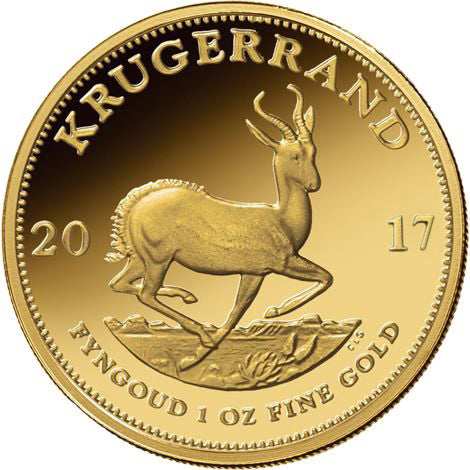
- Features the iconic springbok antelope on the reverse
- No traditional face-value denomination
- One of the world’s longest-running modern gold bullion coin programs
1 oz Gold Krugerrand Specifications
| Metal | Gold |
| Fine Gold Weight | 1.000 troy oz |
| Total Weight | 33.930 grams |
| Composition | 91.67% gold, 8.33% copper |
| Purity | .9167 fine gold / 22 karat |
| Diameter | 32.69 mm |
| Face Value | No traditional denomination |
| Country | South Africa |
| Obverse Designer | Otto Schultz |
| Reverse Designer | Coert Steynberg |
| First Year Issued | 1967 |
The Paul Kruger Obverse
The obverse features a portrait of Paul Kruger, former president of the South African Republic. The portrait was originally modeled by die engraver Otto Schultz and traces its origins to South African coinage produced during the late nineteenth century.
The inscriptions SOUTH AFRICA and SUID-AFRIKA appear around the portrait in English and Afrikaans, reflecting the coin’s South African origin.
The Springbok Reverse
The reverse features a prancing springbok, one of South Africa’s most recognizable national symbols. Sculptor Coert Steynberg created the springbok design, which had previously appeared on South African coinage before becoming permanently associated with the Krugerrand.
The reverse also identifies the year of issue and the coin’s gold content. Unlike most sovereign bullion coins, the Krugerrand does not display a conventional monetary denomination.
Why Doesn’t the Krugerrand Have a Face Value?
The Gold Krugerrand was designed differently from most modern bullion coins. Rather than carrying a fixed face value such as $50, £100 or €100, the Krugerrand was created so its value would reflect its gold content and the prevailing market price of gold.
This approach helped establish the Krugerrand as a purpose-built bullion coin rather than a traditional circulation coin with a nominal denomination.
Why Is the Krugerrand 22-Karat Gold?
The Krugerrand’s 22-karat composition does not mean the one-ounce coin contains less than one ounce of gold. Each coin still contains exactly 1.000 troy ounce of pure gold.
Copper is added to the gold to increase the coin’s hardness and durability. That additional copper raises the total weight to approximately 33.930 grams and gives the Krugerrand its distinctive reddish-gold appearance.
This durable alloy helped make the Krugerrand practical for physical ownership and handling while preserving a standardized one-ounce fine-gold content.
The Coin That Helped Create the Modern Bullion Market
The first Gold Krugerrand was struck on July 3, 1967. It was developed as a way to market South African gold directly to private buyers at a time when owning investment gold was becoming increasingly accessible in international markets.
The concept proved extraordinarily influential. For years, the Krugerrand dominated the international gold bullion coin market and helped demonstrate demand for government-issued coins whose value closely tracked their precious-metal content.
Other national mints later introduced their own major bullion programs, including the Canadian Gold Maple Leaf, American Gold Eagle, Australian Kangaroo and Austrian Philharmonic.
Why Buy a 1 oz Gold Krugerrand?
The Krugerrand offers buyers a combination of one full troy ounce of gold, durable 22-karat construction, a long bullion-market history and broad international recognition.
Its standardized one-ounce fine-gold content makes it straightforward to compare its underlying metal value with the current spot price of gold. At the same time, its copper alloy makes it more resistant to scratching and handling than softer 24-karat bullion coins.
For buyers considering internationally recognized sovereign bullion, the Krugerrand provides a historically significant alternative to the American Gold Eagle, Canadian Maple Leaf, Austrian Philharmonic, Australian Kangaroo and Gold Britannia.
Browse American Federal Coin & Bullion’s complete selection of gold coins and bullion or read our Gold Buying Made Simple guide to learn more about owning physical gold.
Frequently Asked Questions
How much gold is in a 1 oz Gold Krugerrand?
Each standard 1 oz Gold Krugerrand contains exactly one troy ounce of pure gold.
Is the Gold Krugerrand pure gold?
The coin is struck from a 22-karat alloy containing 91.67% gold and 8.33% copper. Its total weight is greater than one ounce so that the finished coin still contains exactly one troy ounce of pure gold.
Why does a 1 oz Krugerrand weigh more than one ounce?
The additional weight comes from the copper alloy. The coin weighs approximately 33.930 grams overall while containing one full troy ounce, or approximately 31.103 grams, of pure gold.
Does the Gold Krugerrand have a face value?
The Krugerrand does not display a conventional fixed denomination. It was designed so its market value would reflect its gold content and the prevailing gold price.
When was the first Gold Krugerrand made?
The first Krugerrand was struck in South Africa in 1967.
Who appears on the Gold Krugerrand?
The obverse features Paul Kruger, while the reverse depicts a springbok antelope, one of South Africa’s best-known national symbols.
Is the Gold Krugerrand eligible for a Precious Metals IRA?
Traditional Gold Krugerrands are .9167 fine gold and generally do not meet the .995 minimum fineness requirement applicable to most gold bullion held in a Precious Metals IRA. Buyers should consult their IRA custodian regarding eligible products.
Reviews
There are no reviews yet.